
Cutting Through the Hype: What Is Real Damascus Steel?
A Damascus knife is a blade made by layering different types of steel together to create wavy or watery patterns. These knives are famous because they look unique and often hold a sharp edge very well. Today, most high-quality Damascus is made through a process called pattern-welding.
The price of a Damascus knife can range from 200 dollars for a basic mass-produced blade to over 1,000 dollars for a custom piece. This huge price gap exists because of how the steel is made and the quality of the materials used. Many cheap knives look like Damascus but do not perform like the real thing.
Real Pattern-Welded Steel vs. Mystery Steel
It is important to know if you are buying real pattern-welded steel made from known alloys or a vague “mystery steel” meant only for looks. Real Damascus uses specific types of high-carbon steel that are forged together for strength. Mystery steel is often made from scrap metal that might be soft, brittle, or prone to rusting quickly.
Spotting a Real Forge-Welded Blade
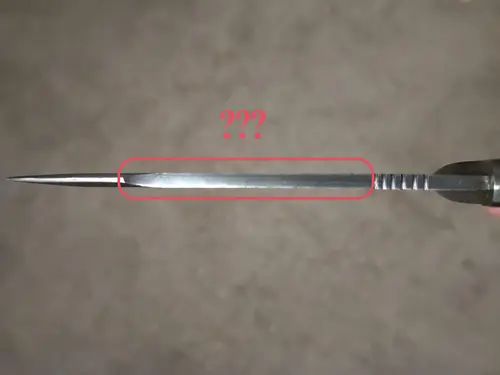
You can tell if the steel is real forge-welded Damascus by checking if the pattern matches on all sides of the blade, including the spine and the handle area. On a real knife, the wavy lines are part of the metal itself, not just on the surface. Here are a few ways to spot a cheap etched fake:
- Look at the spine of the knife to see if the layers continue over the top edge.
- Check for fading because a fake pattern that is just printed or lightly etched will rub off over time.
- Inspect the bolster and tang to ensure the pattern flows naturally through the entire piece of metal.
Investing in Quality
For a 4-5 inch full-tang Damascus hunting or survival knife from a reputable U.S. maker, a realistic price range is usually between 200 and 500 dollars. This price covers the cost of premium steel, the long hours of forging, and proper heat treatment. Buying from a trusted maker ensures the knife is a tool that can actually be used in the field.
Cheaper options usually cut corners to keep the price low. These budget knives often use:
- Lower-grade metal alloys that do not hold a sharp edge for very long.
- Poor heat treatment which makes the blade too soft to use or so brittle that it snaps.
- Acid etching on soft stainless steel to create a fake pattern that looks like Damascus but lacks the layered strength.
How to Spot Fake Damascus Steel
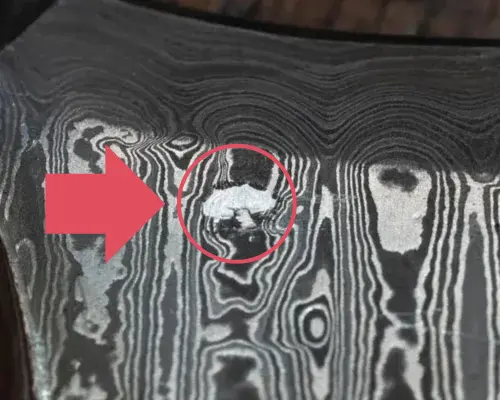
You can spot a fake blade by looking at the spine and the surface. Fake Damascus often has a pattern that stops at the spine or can be scratched off entirely because it is just painted or stamped on the surface. Some makers even coat the blade after stamping it to mimic the look of real forged layers.
The Truth About Low-Quality Damascus
There is a big difference between a blade that looks like Damascus and one that performs like it. Many cheap knives coming from places like Pakistan are technically forge-welded, but they use poor materials. Low-quality Damascus is often made from mild steel or metal with very low carbon content, which means it won’t hold a sharp edge.
Real Damascus patterns come from a specific process:
- Makers combine different types of steel with various carbon levels.
- The steel is folded and forged to create unique looks.
- Common patterns include raindrop, ladder, feather, and twist styles.
Is it Real or Just a Technicality?
While some cheap knives are technically made of layered steel, they are not high-quality tools. Cheap Damascus is real only on a technicality because the metal is poor and the makers spend pennies to produce it. It is like putting a fancy fiberglass car body on a weak frame; it looks fast, but it has no power.
Why Price Matters
The cost of a knife is the easiest way to tell if it is authentic. You will not find a real Damascus knife worth owning for under $200 because the materials and labor are very expensive. Most professional knife makers will never sell their work for less than $150 to $200. If you are spending only $30 on a blade, it is not real Damascus.
Performance Secrets: Patterns, Layers, and Edge Life
Damascus steel for knife making is a blend of two or more types of steel that are forge-welded together to create a single, layered bar. This process requires extreme heat and pressure to bond the metals into one piece.
When buying a high-end blade, you should know the name of the person who forged it, the specific steel alloys and layer count used, and whether the maker or an outside specialist did the heat treatment. Knowing the specific alloys helps you understand how the knife will handle rust and wear. Proper heat treatment is the most important step for ensuring the blade is hard enough to hold an edge but not so brittle that it snaps.
Do Patterns and Layers Change Performance?
Whether a knife has a ladder, twist, or raindrop pattern is almost entirely a cosmetic choice and does not change how the knife cuts. These patterns are created by manipulating the steel during the forging process. While they look beautiful, a specific pattern does not offer better edge retention or toughness compared to simple straight layers.
The Truth About Micro-Serrations
Some people claim that Damascus has a “micro-serration” advantage because the different steels wear down at different speeds. In reality, there is no measurable cutting advantage from micro-serrations in Damascus when compared to a high-quality mono-steel. For most users, this is a marketing claim rather than a functional benefit you will notice during use.
Choosing the Right Mix for Hard Use
If you are looking for a hard-use field knife, you should avoid nickel-heavy Damascus because nickel does not harden as well as high-carbon steel. While nickel provides a bright, shiny contrast that makes the pattern pop, it can reduce the overall hardness of the edge. For a tool you rely on, a harder edge is usually more important than a high-contrast look.
Damascus Patterns and Applications
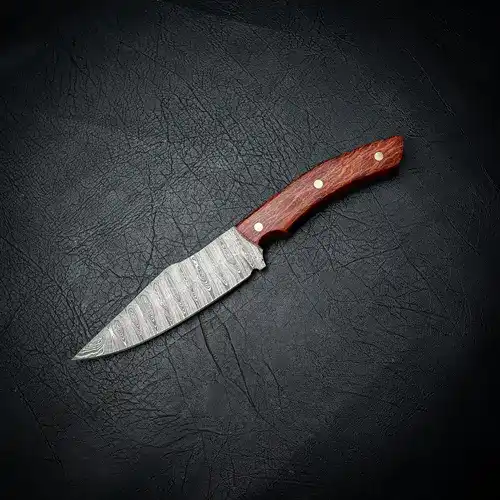
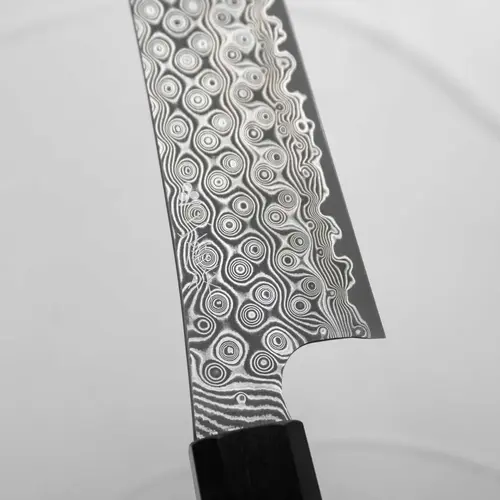
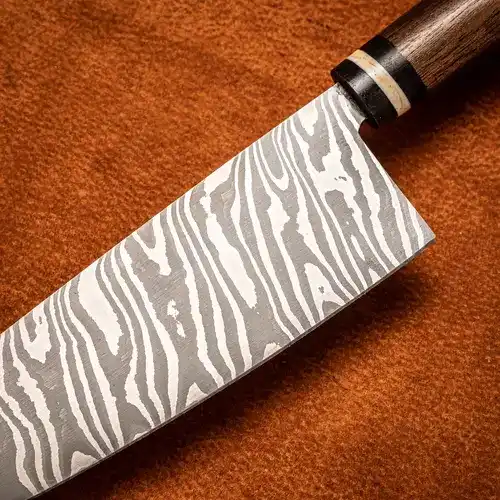
Different patterns are often chosen based on the type of knife and the style of the maker. While they perform similarly, they offer very different looks:
- Twist Pattern: Created by twisting a layered bar, this is common on all knife types and offers a classic “starry” look.
- Ladder Pattern: Made by cutting grooves into the steel and forging them flat, this looks like rungs on a ladder and is popular for large fixed-blade knives.
- Raindrop Pattern: Created by drilling small holes into the layers, this results in circular “droplets” across the blade, often seen on high-end pocket knives.
Investing in Long-Term Sharpness
If you want a knife that stays sharp through a full hunting trip or a long camp weekend, modern powder steel with a Damascus cladding is a better choice than full carbon Damascus. This type of blade uses a high-performance “super steel” for the cutting edge and beautiful Damascus on the sides. This gives you a knife that stays sharp for a very long time while still looking like a work of art.
The EDC Debate: Is Damascus Practical for Every Day?
Choosing a Damascus knife for everyday carry (EDC) depends heavily on the specific steel used in the mix. If a listing just says “Damascus steel” without listing the alloys, a known mono-steel like S35VN or 154CM is a much more practical choice for daily use. These mono-steels offer predictable performance and are easier to maintain than mystery Damascus.
For common tasks like opening boxes and cutting tape, Damascus is often more of a liability than an advantage because sticky residue can hide in the etched pattern. If you hit a metal staple, a high-contrast Damascus blade may be harder to repair than a standard steel blade. The beauty of the pattern can also make you hesitant to use the tool for rough tasks.
Finding the Right Edge Thickness
If you want a thin, slicey knife for detail work, you must be careful with how fine you grind the edge. For most Damascus blends, the edge should not go below a 15-to-20-degree angle per side to prevent chipping during regular use. Going thinner than this can cause the delicate layers to fail when they hit hard materials.
Food Prep and Reactivity
Using your Damascus knife for a quick snack or cutting fruit requires extra care. Because most traditional Damascus is made of carbon steel, the blade will react with acidic foods like lemons or apples and can leave a metallic taste on the food. This reaction will also change the look of the blade by creating a dark patina or causing the pattern to fade.
Carrying in Texas
If you are carrying a Damascus folder in Texas, you will find the laws are very open compared to other states. There are no specific blade length or locking-mechanism restrictions for most adults in Texas, as “illegal knives” were removed from the law in 2017. You can carry almost any type of folder or fixed blade as long as you are not in a restricted location like a school or courthouse.
Built for the Wild: Hunting and Camping Performance
When processing big game like elk or deer, the ideal blade length is 4 to 5 inches with a thickness of about 1/8 to 5/32 of an inch to prevent chipping on light bone. This size provides enough reach for deep cuts while remaining thick enough to handle accidental contact with ribs or joints. A blade in this range offers the best balance of control and durability for field dressing.
If you want one custom knife to handle both daily carry and light camping, you should ask for a slightly thicker spine and a taller blade to ensure it can handle light prying or wood processing. While a slim profile is better for a pocket, the extra height in the blade adds strength and creates a better geometry for outdoor tasks. This small trade-off in “pocketability” makes the knife much more capable once you leave the pavement.
The Hardness Sweet Spot
A Damascus hunting knife needs a specific level of hardness to be useful in the woods. The “sweet spot” for a Damascus hunting blade is between 58 and 60 on the Rockwell hardness scale so it stays sharp through multiple animals but can still be fixed with a simple field stone. If the steel is harder than 60, it becomes very difficult to sharpen without professional tools. If it is softer than 58, the edge will roll or dull before you finish skinning a single large animal.
Heavy Duty Camping Tasks
For a general camping knife, you should request a 4 to 6 inch all-purpose fixed blade with a flat or convex grind to handle food prep, rope, and light batoning. This length is the standard for a “do-it-all” camp tool because it is nimble enough for the kitchen but long enough to split small kindling. A stout fixed blade is much safer than a folding knife when applying the force needed for woodcraft.
Durability Under Pressure
Many users worry about the layers of a Damascus blade coming apart during tough work. Modern laminated or clad Damascus is extremely unlikely to delaminate or chip when batoning through knotty wood as long as the forge-welds were done correctly. While a bad weld can fail, high-quality Damascus acts as a single solid piece of steel. Even if you accidentally twist the blade in a deep cut, the layered structure is often tougher than a single piece of brittle high-carbon steel.
Choosing Your Steel Mix
When choosing between different metal mixes for a hard-use outdoor knife, you must decide between edge life and ease of care. You should prioritize a tough carbon Damascus mix like 1095 and 15N20 for heavy camping because it is easier to sharpen and more impact-resistant than fancy stainless mixes. While stainless Damascus looks great and resists rust, it is often more brittle and harder to repair if the edge gets damaged in the field. Carbon steel will develop a dark patina over time, but its reliability in the wild makes it the preferred choice for many outdoorsmen.
Keeping the Shine: Maintenance and Field Care
A Damascus steel knife requires regular cleaning and a light coat of oil to prevent rust and corrosion. Unlike standard stainless steel, the layers in Damascus can be more sensitive to the environment. You should clean and oil your blade every time it comes into contact with moisture, blood, or acidic materials.
The beautiful etched pattern on your knife will not wear off with normal use, but it can fade if you use abrasive cleaners or if the blade is polished too much. If the pattern does start to look dull, it can often be brought back by a professional using a fresh acid etch.
Field Maintenance and Sharpening
When you are out on a hunt, you must wipe the blade dry immediately after use and apply a fresh layer of oil before putting it back in a leather sheath. Leather can hold moisture against the steel, which causes rust to form quickly. Blood and animal tissue can stain Damascus more noticeably than plain carbon steel, but this usually creates a unique patina rather than ruining the pattern.
Sharpening a Damascus knife should be done with high-quality stones or a guided system to ensure you do not scratch the etched pattern on the sides of the blade. You only want to sharpen the very edge of the knife. Here is how to handle a Damascus blade in the field:
- Use a food-safe oil if you plan on using the knife for cooking or processing game.
- Carry a small microfiber cloth to wipe away fingerprints and oils from your skin.
- Avoid long-term storage in leather because the chemicals used to tan leather can sometimes react with the metal.
Managing Corrosion on a Working Blade
A darker etched finish can help hide small scratches from hard work, but it can also make tiny rust spots much harder to see until they become a problem. You should inspect a dark blade closely under a bright light to catch any orange spots early.
If this is your only knife for a long trip, it is smarter to choose a tough carbon Damascus and commit to frequent maintenance rather than a stainless version that might be harder to fix if the edge chips. Carbon steel is more forgiving in the woods and easier to keep sharp with basic tools.
Working with a Maker: How to Order Custom
When you start looking for a bladesmith, you must determine if the maker is reputable and actually doing custom work or just reselling and importing semi-custom blades. A true custom maker will be able to discuss the specific steel types and the forging process in detail. If the seller cannot answer technical questions about how the blade was made, they may just be a middleman for factory-made imports.
Managing Your Investment Safely
Ordering a custom knife involves a level of trust between you and the maker. Paying a full deposit up front without seeing drawings, progress photos, or a clear timeline is generally a red flag. Most established makers will ask for a smaller deposit to cover materials and then provide updates as they work. You should expect regular communication that includes:
- Initial sketches or drawings to confirm the design matches your vision.
- Photos of the progress so you can see the blade as it moves through the forging and grinding stages.
- Updates on the timeline if there are any delays in the shop.
Designing Your Knife
You do not need to be an engineer to get a great custom tool. Hand sketches and a written spec sheet are usually good enough for most makers, so you do not need to provide a professional CAD drawing. The maker will use their expertise to turn your rough ideas into a functional design.
If you have a favorite knife from another brand, you can use it for inspiration, but there is a limit. Asking a maker to ‘copy’ a knife from another brand should be limited to general shapes and features, as ripping off an exact design is considered disrespectful in the community. Most makers prefer to take your favorite elements and add their own style to create something unique.
Ownership and Warranties
It is important to understand who owns the design after the work is done. If a maker uses your design idea for a drop-point camp knife, they typically keep the rights to the design and can sell copies to other customers later. Unless you have a specific legal agreement for a “one-off” piece, the maker owns the intellectual property of the physical knife they built.
You should also have a clear conversation about what the warranty covers. You need to know if the maker will stand behind the knife if there are issues with the heat-treat or the structure, and if they can tune or modify the design after you have used it. A good maker will want their tools to perform well and will often offer to sharpen or fix minor issues for the life of the tool.
Understanding Wait Times
Quality craftsmanship takes time, especially when dealing with layered steel. A normal wait list for a serious custom maker doing Damascus hunting knives can be several months or even over a year. If a maker claims they can ship a fully custom Damascus knife in just a week or two, it is often a bad sign. This usually means they are using pre-made blanks rather than forging the steel themselves.
Grip and Feel: Handles and Ergonomics
A knife is only as good as your ability to hold it, so you must ensure the handle and balance are comfortable for extended cutting and camp chores while staying secure when wet, cold, or gloved. A poorly designed handle can lead to hand cramps or dangerous slips during heavy work. Custom makers often balance the knife at the bolster to make it feel lighter and more agile in your hand.
To protect your investment, you should pair a fancy Damascus blade with a “beater” knife or multi-tool for really rough tasks so you do not abuse the custom piece. While high-quality Damascus is tough, using it for tasks like prying or scraping can damage the finish or the edge. Having a secondary tool for “dirty” work keeps your custom knife in peak condition for precision cutting.
Choosing the Right Handle Material
The material you choose for your handle affects both the look of the knife and how it performs in the field. Different materials react differently to moisture and age:
- Micarta and G10 provide the best grip for hunting and camping in wet or cold conditions because they do not shrink, crack, or get slippery when bloody.
- Wood handles offer a classic look and feel but can swell or crack over time if they are not stabilized with resin.
- Antler and bone are very durable and traditional, but they can become smooth and slippery over years of use and may require texturing for a better grip.
Custom Fitting for Your Hand
One of the biggest benefits of a custom knife is that the maker can tweak the handle shape or thickness for larger hands without changing the balance or weight noticeably. By hollowing out the steel under the handle scales or using lighter spacers, a maker can create a beefy grip that still feels perfectly balanced. This ensures the knife feels like a natural extension of your arm rather than a bulky tool.